

The growing challenge in technical field services
Technical service organisations across sectors such as energy, utilities, infrastructure, and industrial maintenance are dealing with increasing operational pressure. Installations are becoming more complex, service expectations are rising, and experienced technical specialists are retiring faster than they can be replaced.
At the same time, field teams are often expected to solve problems during the first visit. A failed first-time fix can lead to additional travel, missed SLA targets, operational downtime, and frustrated customers.
In practice, many organisations face the same situation repeatedly.
A field technician arrives on-site and discovers that the fault is more complicated than expected. The technician calls a senior engineer for support. Over the phone, they try to describe the issue, explain what they see, and troubleshoot remotely through verbal instructions alone.
That process takes time. Miscommunication is common. And if the issue cannot be solved remotely, a second visit must be planned with additional expertise.
For field service teams, the problem is not a lack of effort. It is a lack of direct visibility between the technician on-site and the expert supporting remotely.
What a live bodycam adds in practice
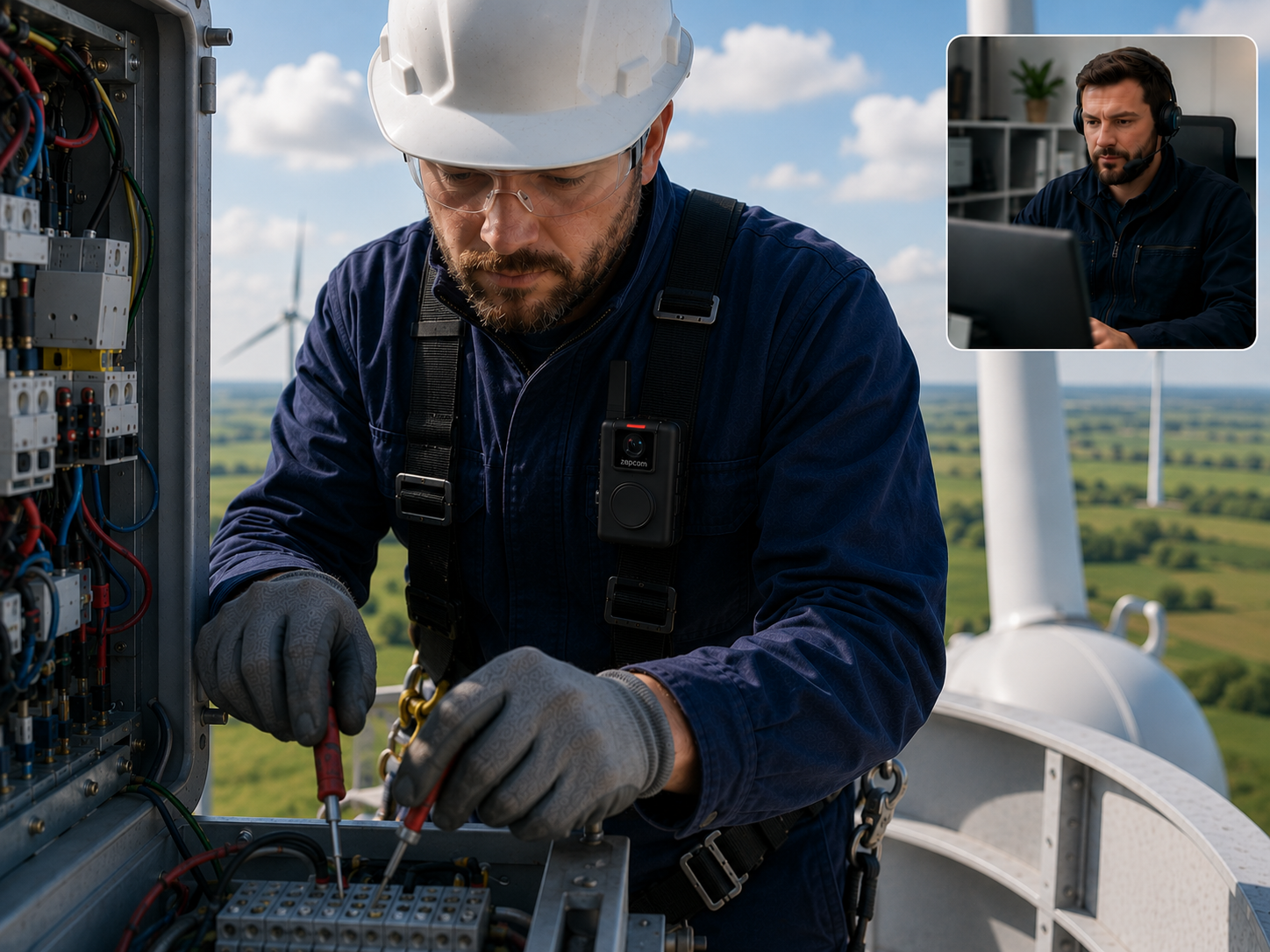
A live-streaming bodycam creates a direct visual connection between the field technician and remote support teams.
Instead of relying only on phone calls or written descriptions, senior engineers can see exactly what the technician sees in real time. That allows remote experts to guide diagnostics, validate decisions, and support repairs immediately without travelling to the site themselves.
In a ZEPCAM setup, this typically includes:
- a ruggedised bodycam mounted on the technician’s chest or helmet
- live video streaming over 4G or WiFi
- remote viewing through ZEPCAM Manager on desktop, tablet, or mobile
- secure recording and storage of service interventions
- integration with existing communication workflows
One of the key operational advantages is that technicians keep both hands free throughout the intervention.
Unlike improvised solutions such as smartphones or handheld video calls, a body-worn camera continuously streams from the technician’s point of view without interrupting the work itself. This is especially important in technical environments where engineers may be climbing, handling tools, working at height, or operating in confined spaces.
A bodycam does not replace technical expertise. It helps organisations use existing expertise more effectively across multiple locations at the same time.
A situation many field service teams will recognise
A technician is dispatched to a remote solar installation after a fault alert appears in the monitoring system. On arrival, the exact cause of the issue is still unclear.
Before starting the inspection, the technician activates the ZEPCAM bodycam. The live feed becomes immediately visible to the remote support team in the operations centre.
As the inspection begins, a senior engineer notices unusual discolouration on part of the inverter system — something that could easily have been overlooked during a phone call discussion alone.
Using live communication alongside the video feed, the engineer guides the technician step by step through the diagnostic process. Because both people are looking at the same situation in real time, decisions can be made faster and with greater confidence.
The intervention is completed during the first visit.
Afterwards, the footage is securely stored as part of the service documentation. The recording provides a clear overview of the original issue, the actions taken, and the final result delivered on-site.
A live bodycam does not replace technical expertise in field service operations. It strengthens it by adding real-time visual insight, reducing miscommunication, and helping remote specialists guide technicians more effectively.
What organisations are seeing
Organisations using live bodycams for remote technical support often report improvements across several operational areas.
First-time fix rates improve because technicians receive direct expert guidance during the intervention itself. Repeat callouts become less common, reducing travel costs and operational delays.
Senior engineers can support multiple field teams remotely instead of spending large amounts of time travelling between locations. This allows organisations to make better use of limited specialist expertise without immediately increasing headcount.
Service quality also becomes easier to document. Recorded footage provides a clear visual record of completed work, helping with reporting, warranty discussions, incident reviews, and customer communication.
There is also an important safety benefit.
In technical environments involving electrical systems, confined spaces, industrial machinery, or working at height, live visibility provides an additional layer of support. Remote colleagues can monitor the situation in real time and respond more quickly if conditions change or an incident occurs.
For lone workers especially, knowing that someone can directly see the situation often increases the sense of safety during complex interventions.
Before entering the hazardous zone, the operator activates the device. Recording starts immediately, while a live stream is sent to the command post over 4G or another available network.
From a safe location, the incident commander and specialists open ZEPCAM Manager on a laptop or tablet. They can now see exactly what the responder sees. Communication continues through the existing radio workflow, but now with visual confirmation.
This improves the quality of decision-making. Leaks, material reactions, access issues or structural concerns can be identified earlier. Tactics can be adjusted faster. Additional resources can be deployed more effectively. In some cases, it may also reduce the need for extra personnel to enter the hazardous area unnecessarily.
Why visibility matters in modern field service
The skills shortage in technical field services is unlikely to disappear anytime soon. Experienced engineers remain difficult to replace, while operational demands continue to increase.
For many organisations, the challenge is therefore not only finding more expertise, but making existing expertise more accessible across the workforce.
Live bodycam technology helps bridge that gap by connecting field technicians directly with remote specialists in real time. It improves visibility, supports faster decision-making, strengthens documentation, and helps organisations maintain service quality under pressure.
In modern technical operations, the expertise does not always need to be physically on-site.
It simply needs to see what is happening.