

It is a legitimate concern. A bodycam is worn by an employee, potentially records colleagues and members of the public, and can capture video, audio, location data and information about sensitive incidents. Employees therefore need to understand not only why bodycams are being introduced, but also the bodycam privacy rules that determine when they may be used and what happens to the footage afterwards.
For organisations, addressing these questions early is important. A successful bodycam deployment depends not only on technology, but also on trust, transparency and clear agreements about how that technology will be used.
The key distinction is between using a bodycam to protect employees and document relevant incidents, and using cameras for general workplace surveillance.
Set clear bodycam privacy rules before deployment
Every bodycam deployment should start with a clearly defined purpose.
An employee may feel comfortable activating a bodycam during an aggressive confrontation, but feel very differently if they believe the same device could be used to monitor conversations with colleagues or routinely evaluate their performance.
Organisations should therefore establish clear rules about when recording is justified and when it is not.
Depending on the deployment, a bodycam policy should address:
- when employees may activate recording;
- whether continuous recording is permitted or necessary;
- who may access recordings;
- for which purposes footage may be reviewed or shared;
- when live video or GPS information may be accessed;
- how long recordings are retained;
- how footage is deleted when it is no longer required.
These rules should be established before bodycams are deployed and communicated clearly to the people who will wear them.
When employees know where the boundaries are, a bodycam is much easier to understand as a safety and evidence tool rather than a workplace surveillance device.
How does GDPR apply to bodycams?
Bodycam footage can contain personal data. This can include identifiable images, voices, locations and information about the circumstances surrounding an incident.
For organisations operating in Europe, this means GDPR and bodycam data protection requirements need to be considered from the beginning.
Organisations need a valid purpose and appropriate legal basis for processing personal data, and the personal data collected should be limited to what is necessary for that purpose.
Employees should therefore be able to understand:
- why bodycams are being used;
- when recording may take place;
- who is authorised to access bodycam footage;
- why a recording may be accessed;
- whether footage can be downloaded or shared;
- who can access GPS information or live video;
- how long recordings remain available.
A Data Protection Impact Assessment, or DPIA, may also be required when the planned processing is likely to result in a high risk to people’s rights and freedoms. For bodycam projects, considering privacy risks before deployment is particularly important.
Privacy officers, employee representatives and, where applicable, works councils should therefore be involved early in the process rather than after the technology has already been introduced.

How long should bodycam footage be stored?
There is no universal retention period that is suitable for every bodycam deployment.
Bodycam retention rules should reflect why footage was collected in the first place and how long it is genuinely required for that purpose.
A recording related to an incident, complaint or investigation may need to be retained for a different period than footage that has no further operational or evidential value.
What organisations should avoid is keeping all bodycam footage indefinitely simply because storage capacity is available. Under GDPR, personal data should not be retained longer than necessary for the purpose for which it was collected.
A bodycam policy should therefore establish retention periods in advance and apply them consistently. Where different types of recordings require different retention periods, these should also be clearly defined.
Make privacy part of the technology
Written policies are essential, but privacy becomes much stronger when the technology itself helps enforce them.
A professional bodycam system should make it possible to control who has access to recordings and provide accountability when footage is viewed, managed or shared.
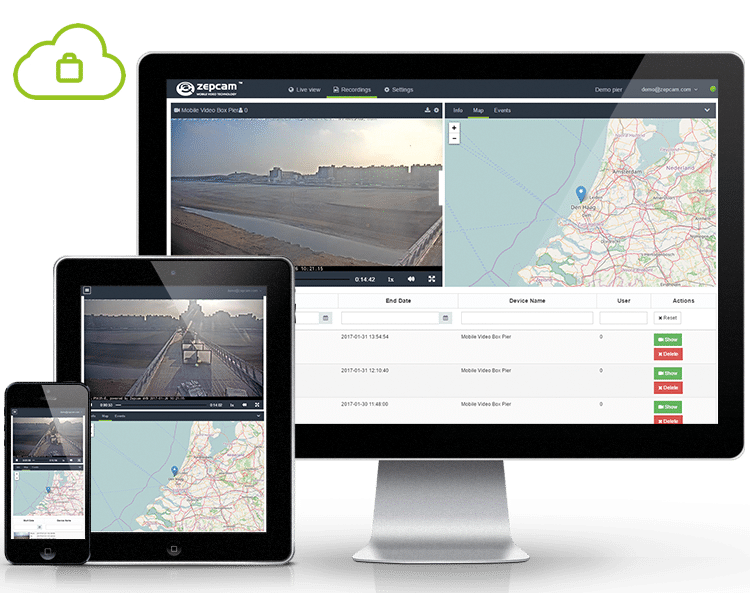
With ZEPCAM Manager, organisations can configure role-based access rights, manage retention settings and use audit functionality to track activity within the system. Video and audio redaction tools can also be used when recordings need to be shared while protecting the identity or privacy of people captured in the footage.
ZEPCAM also supports different deployment models, including cloud, on-premise and hybrid configurations, allowing organisations to choose an architecture that matches their operational, security and data protection requirements.
The same principle applies to functions such as GPS and live video. Access should be limited to authorised users and linked to a clearly defined operational purpose.
This moves bodycam data protection beyond internal promises. Privacy requirements can be reflected directly in the way the system is configured and managed.
Bodycams can protect employee privacy too
Discussions about bodycam privacy often focus on the risk of employees being monitored.
There is another side to that discussion.
Bodycam footage can also protect the person wearing the camera.
When an employee experiences aggression, faces a disputed interaction or is confronted with a complaint afterwards, objective footage can help establish what actually happened. Instead of relying solely on conflicting accounts or memories, the organisation has an additional source of evidence available for review.
This can be particularly valuable in environments where frontline professionals regularly interact with members of the public.
At Leiden University Medical Centre, security employees using ZEPCAM bodycams reported feeling safer while wearing them. Recordings have also provided evidence in cases involving the police and when responding to false complaints from patients, visitors and family members.
Importantly, employees are trained to determine when recording is necessary. This helps capture relevant incidents without turning routine working situations into continuous surveillance.
The distinction matters. A properly implemented bodycam is there to support and protect frontline employees, not to constantly monitor them.
Privacy and safety do not have to compete
Organisations sometimes approach bodycam privacy as a trade-off.
Either employees gain additional protection, or they give up part of their privacy.
A well-designed deployment should not require that choice.
Clear activation rules limit unnecessary recording. Role-based permissions restrict access to footage. Retention policies prevent recordings from being stored indefinitely. Audit logs create accountability around access, while redaction makes it possible to protect identities when footage needs to be shared.
Technology, policy and training need to work together.
When they do, organisations can gain the safety and evidential benefits of bodycams while maintaining clear privacy boundaries for employees and the public.
Five questions every employee should be able to answer
Before bodycams are introduced into the workplace, every employee wearing one should be able to answer five basic questions:
- Why are bodycams being used?
- When may recording start?
- Who can access the recordings?
- How long is bodycam footage stored?
- For which purposes may footage be used?
If these questions cannot be answered clearly, the organisation’s bodycam policy needs more work.
Good bodycam data protection is not about choosing between privacy and employee safety. It is about defining a clear purpose, setting appropriate limits, controlling access and making sure employees understand exactly how the technology is used.
That is what turns a bodycam into a tool that protects employees and provides reliable evidence, rather than a system for monitoring the workforce.