
For an organisation funded by voluntary contributions, authentic footage from real missions has clear value. It can show supporters what rescue crews actually face at sea. The problem is that a rescue cannot be scheduled, restaged or interrupted for a camera crew. KNRM therefore needed a body camera system that could capture first-person footage without changing the way a rescue is carried out.
Case at a glance
|
Organisation |
KNRM, Royal Netherlands Sea Rescue Institution |
|
Challenge |
Capture authentic footage from unpredictable rescue missions without delaying launches or distracting the crew. |
|
Solution |
ZEPCAM T3 bodycams combined with tailored mounting, a privately hosted transfer and storage workflow, and central support. |
|
Technology |
On-device recording, GPS, configurable pre-recording and a large main button for intuitive start/stop recording, including with gloves. |
|
Operational context |
Around 45 rescue stations, roughly 1,00 volunteers and about 75 lifeboats across the Netherlands. |
|
Integration partner |
Stream My Event |
The challenge: real rescue footage without slowing the crew
A sea rescue is a difficult environment for any recording system. Crews wear heavy survival suits and may be handling lines, navigating close to another vessel or moving around a deck in high waves. A camera cannot compromise the survival suit, add time to a launch or require repeated attention once the operation is under way.
The fleet creates a second problem. KNRM operates everything from roughly five-metre inflatables launched from the beach to nineteen-metre all-weather lifeboats and heavy coastal rescue vehicles. A mounting method that works on one platform may be useless on another. Connectivity also varies from station to station, so the recording workflow could not depend on a fast network connection while a mission was in progress.
Why the ZEPCAM T3 fits the rescue workflow
Stream My Event selected ZEPCAM as the bodycam partner and built the system around ZEPCAM T3 bodycams. The T3 is a body-worn camera designed for frontline use, with local recording, GPS and a physical main button on the front of the device.
Recording is started deliberately by the crew member. The wearer presses the large main button on the front of the T3 to start or stop recording. The control is designed to be operated intuitively, including while wearing gloves. This matters in a rescue environment: one deliberate action starts the recording, after which the crew member can return their attention to the mission.
The T3 also supports configurable pre-recording of up to 120 seconds. When enabled, this preserves footage from immediately before the record button is pressed, adding context to the start of an event. Video is recorded on the device using H.264 compression, while GPS can provide location context alongside the footage.
Engineering the system for boats, vehicles and survival suits
Choosing the camera was only part of the project. Stream My Event also had to make the equipment work across KNRM’s varied fleet and protective clothing. Camera mounting on survival suits went through its own trials to find a position that stayed secure without interfering with the suit’s primary safety function.
For boats and vehicles, the integrator designed and 3D-printed a family of custom mounts. Closed cabins can become extremely hot in direct sun, while equipment is exposed to constant UV and vibration. Standard plastics warped, so the team moved to a heat- and UV-resistant engineering resin.
The mounts have gone through roughly fifteen iterations, with changes driven by feedback from KNRM crews in the field. A later move to a GoPro-style attachment standard opened up an existing ecosystem of proven accessories, allowing custom engineering to be reserved for the problems that are genuinely specific to KNRM.
Getting footage ashore without making connectivity a dependency
The KNRM setup uses server infrastructure hosted by Stream My Event rather than routing the footage through a ZEPCAM-hosted environment. After a mission, recordings move into Stream My Event’s post-production workflow and its backed-up storage infrastructure.
Transfer happens after the action. Depending on the station and available connection, footage can move through a wired connection when a camera is docked, Wi-Fi, 4G or satellite. Delivery may take a few hours or, at more remote locations, a few days. That delay is acceptable because recording does not depend on the upload connection while the crew is at sea.
Support was also designed for a distributed volunteer organisation. Each station can raise its own ticket, issues are handled centrally, and a QR code placed where crews collect their equipment gives them a quick way to report a problem.
Proof at sea: the Eva Schulte rescue
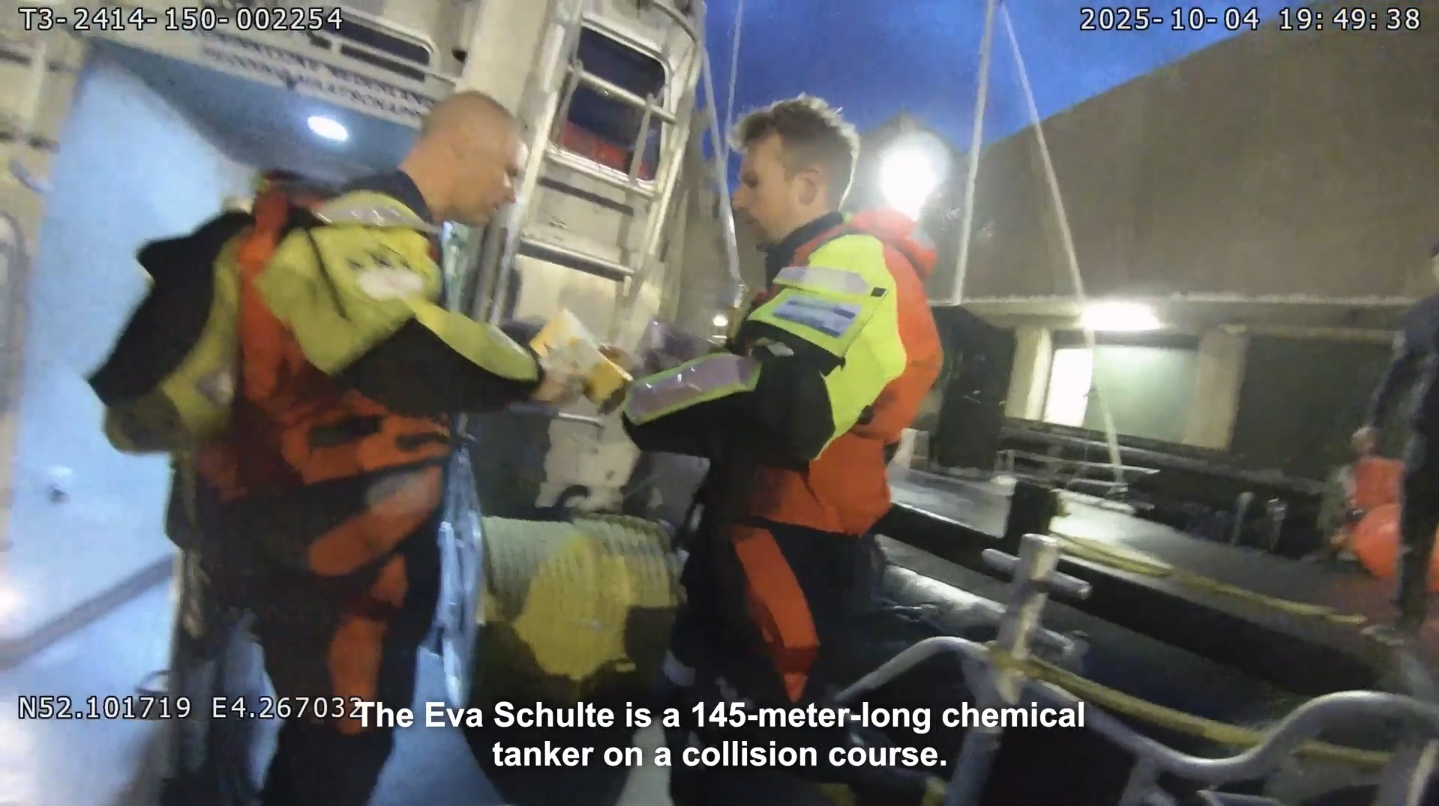
The clearest proof of the system is the footage itself. On 4 October 2025, the 145-metre chemical and oil products tanker Eva Schulte lost engine power about 37 kilometres west of IJmuiden and began drifting towards the Hollandse Kust Zuid offshore wind farm. There were 21 people on board. The Dutch Coast Guard reported Force 8 winds and waves of around five metres while attempts were made to secure the vessel.
KNRM lifeboat Kitty Roosmale Nepveu assisted the emergency tug Multraship Protector. At 23:16, the Coast Guard reported that a tow connection had been established and the priority was to move the tanker away from the wind farm.
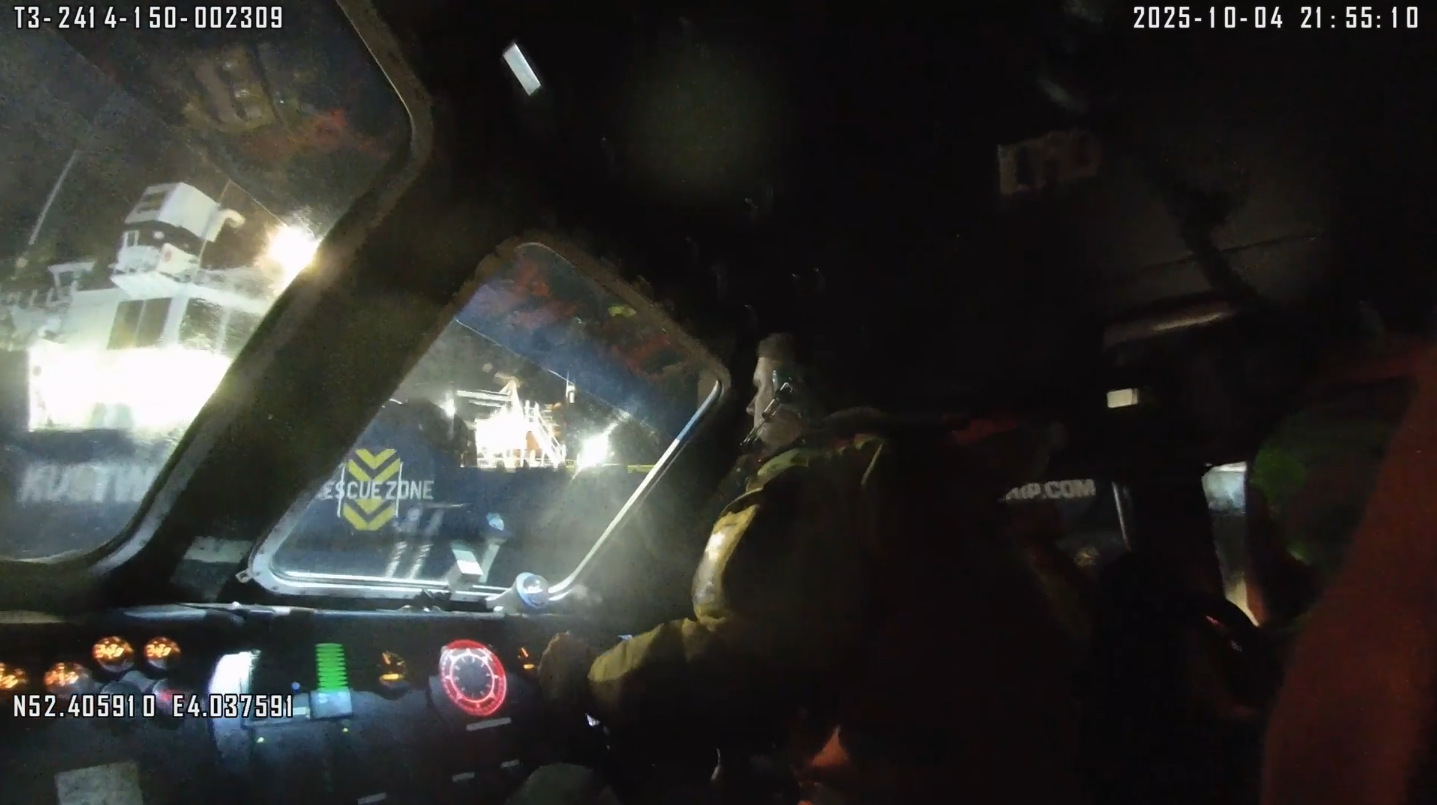
ZEPCAM T3 bodycam footage captured the operation from multiple first-person perspectives. The video shows the crew working on deck in darkness and heavy seas, operating close alongside the tanker and handling the towline while the rescue boat moves continuously beneath them. Time and location information are visible in the footage, creating a clear visual record of where and when key moments occurred.
This is the kind of operation that is difficult to explain afterwards with a written report alone. The bodycam footage preserves the working conditions, the proximity of the vessels and the sequence of actions as the crew experienced them, without placing a separate camera operator in the middle of the rescue.
Why authentic first-person footage matters to KNRM
KNRM already uses bodycam footage more broadly in its public storytelling. On its Redders op zee page, the organisation explains that crew members wear bodycams over their survival suits during rescues and that the resulting action footage forms part of the basis of the television series.
That context matters. KNRM is a charitable organisation funded by voluntary contributions rather than government subsidies. First-person footage gives the public a view of rescue work that is almost impossible to reproduce in a staged setting. The ZEPCAM T3 deployment gives KNRM and its production partner a structured way to capture that kind of footage during real missions and move it into a secure post-production workflow afterwards.
Outcome: a bodycam workflow built around rescue work
KNRM’s workflow depends on three practical choices: It is the way the complete workflow has been adapted to the job: a large recording button that can be used with gloves, body-worn mounting that respects the survival suit, custom hardware for very different vessels, local recording when connectivity is limited, and a transfer and support process that works across a distributed network of stations.
For organisations that need first-person video from unpredictable frontline work, the lesson is practical. The right body camera system has to fit the operation from the moment recording starts to the moment the footage reaches storage. KNRM’s use of ZEPCAM T3 bodycams shows what that looks like when the technology is designed around the people doing the work, rather than asking the people to work around the technology.