

A familiar challenge across public transport
Every day, NS conductors and municipal enforcement officers help hundreds of thousands of passengers travel safely across the Netherlands.
They provide information, assist travellers, enforce regulations, and manage difficult situations.
Unfortunately, they also face aggression and intimidation on a regular basis.
Verbal abuse, threats, and physical incidents remain a persistent challenge across public transport networks throughout Europe.
For NS, bodycams offered an opportunity to support three important objectives at the same time:
- improving employee safety
- helping prevent aggressive behaviour
- creating reliable evidence when incidents occur
The vision was clear.
Delivering it at scale required much more than selecting a camera.
Thinking beyond the device
From the beginning, NS approached the project as a large-scale IT and implementation programme rather than a hardware purchase.
The scope included thousands of devices, software integration, managed services, user training, support processes, and long-term operational management.
Before a single bodycam could be issued, important questions had to be answered.
How would footage be stored securely and in compliance with GDPR requirements?
Who would have access to recordings, and under what conditions?
How would thousands of employees be trained to use the technology correctly?
How would bodycam workflows fit into existing systems and operational procedures?
These were not secondary considerations.
They were the project.
Choosing a partner, not just a supplier
Following an earlier pilot phase, NS selected ZEPCAM to deliver the nationwide rollout.
Integration into the NS environment began on 1 December 2025.
On 15 June 2026, exactly according to plan, the national deployment went live.
ZEPCAM’s role extended far beyond supplying hardware.
The project included the complete implementation lifecycle.
Secure video management
All recordings are processed and stored within a controlled environment designed to maintain the integrity of the evidence chain.
Footage remains protected throughout its lifecycle, from recording to retrieval.
Access control and accountability
Role-based permissions ensure that recordings are only accessible to authorised personnel.
Every access request and viewing action is logged, providing a complete audit trail.
Centralised device management
Managing thousands of bodycams requires continuous visibility into device status, firmware updates, connectivity, and operational readiness.
ZEPCAM provides centralised management capabilities that allow administrators to monitor the deployment at scale.
Support and operational management
Bodycam programmes require ongoing support long after deployment.
ZEPCAM worked closely with NS to establish support processes, management workflows, and integration with existing operational systems.
Process integration
A bodycam should not become a separate process that employees have to remember.
The technology needs to fit naturally within existing workflows.
By integrating bodycam procedures into established NS operations, the solution became part of everyday work rather than an additional administrative burden.
Privacy and compliance
For any public-facing organisation, privacy is essential.
GDPR compliance was treated as a design requirement from the start of the project, not as something to address afterwards.
Training and adoption
Technology alone does not create successful deployments. People do.
The rollout included comprehensive training covering:
- device operation
- smartphone app usage
- operational procedures
- legal frameworks
- soft skills
- bodycam best practices
The objective was not simply to train users, but to ensure they felt confident using bodycams in real-world situations.
How the solution works in practice
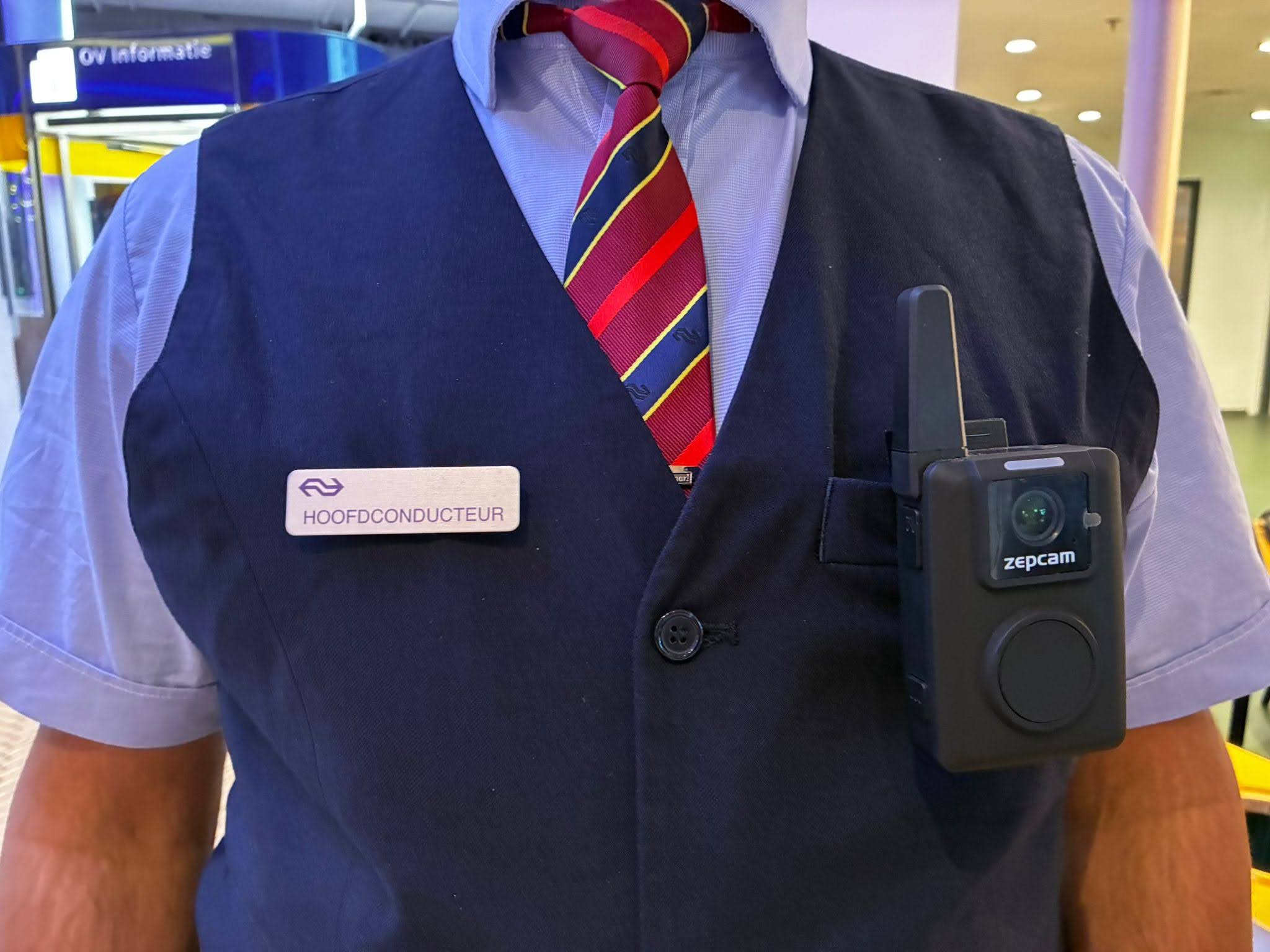
For a conductor, using a bodycam is designed to be straightforward.
The device is activated as part of the standard pre-departure routine.
If an incident occurs during a shift, recording can be started immediately with the press of a button.
Once footage has been captured, recordings are automatically transferred wirelessly to the secure ZEPCAM platform. Metadata is added automatically, and footage is stored according to NS retention policies.
Access to recordings is tightly controlled.
If footage needs to be reviewed, authorised personnel can retrieve it through ZEPCAM Manager, with every action fully logged.
The employee is protected.
The evidence remains secure.
The process is consistent and repeatable across thousands of users and locations.
The next phase: adoption at scale
With the rollout now live, the focus shifts towards long-term adoption.
Over the coming months, approximately 4,000 employees will continue receiving training and support to ensure bodycams become a natural and effective part of daily operations.
This stage is often overlooked in technology projects.
Deployments do not succeed because devices are distributed.
They succeed because people understand when, why, and how to use them.
ZEPCAM’s training approach focuses on practical adoption and operational confidence rather than simply completing an e-learning programme.
What other organisations can learn
The NS project demonstrates an important lesson for any organisation considering bodycam technology at scale.
The challenge is rarely the camera itself.
The challenge is implementation.
Large-scale deployments involve privacy, IT infrastructure, user adoption, support processes, governance, and operational integration.
When those elements are addressed properly, complexity becomes manageable.
The market is increasingly moving beyond standalone devices towards secure, scalable, professionally managed bodycam ecosystems.
NS provides a clear example of what that looks like in practice.
The takeaway
A successful bodycam programme is not defined by the number of devices deployed.
It is defined by how effectively those devices are integrated into everyday operations.
By combining secure technology, structured implementation, privacy-first design, and long-term user adoption, NS has created a foundation for one of Europe’s largest bodycam deployments in public transport.
For organisations considering a similar journey, the lesson is simple.
Deploying bodycams is relatively easy.
Building a bodycam programme that works at scale is where the real expertise matters.